Hair Loss Treatment for Women in Neenah, WI
Most women notice it in the part line first.
Female hair loss is common, it is under-discussed, and it responds far better to early treatment than to late treatment. The follicles that have thinned can often be revived; the ones that have been dormant for years usually cannot.

What is actually happening
Miniaturisation, not disappearance.
In female pattern thinning the follicles do not vanish — they shrink. Each growth cycle produces a slightly finer, shorter, less pigmented hair, until what grows is a barely visible vellus hair rather than a terminal one. The follicle count stays similar; the hair you can see does not.
That is why the part line widens before anywhere else. Density loss reads first where the scalp is already most exposed, which is also why people notice it in photographs before they notice it in a mirror.
Blood supply and the scalp environment matter enormously. A follicle needs consistent circulation and nutrient delivery to sustain a full growth cycle, and treatments that improve the scalp environment work by giving miniaturising follicles a chance to recover.
There are also causes that are not pattern loss at all — thyroid disease, iron deficiency, postpartum shedding, significant stress, and rapid weight loss including from GLP-1 medication. Several of these are correctable, and a blood panel is often the highest-value first step.
What we can do about it
Three parts to a hair plan.
In-clinic treatment does the heavy lifting, but hair is a systemic tissue — what is happening internally shows up on the scalp months later.
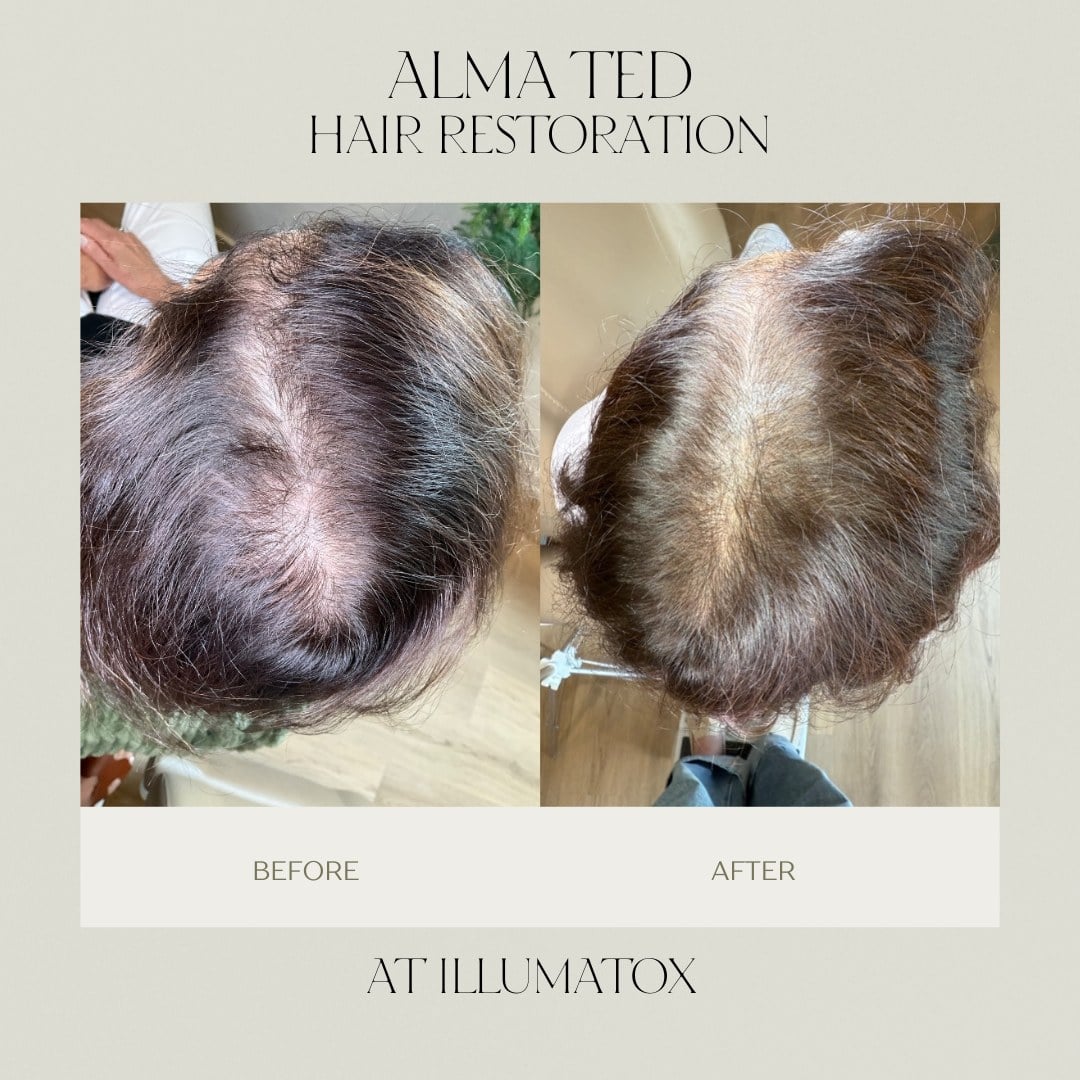
- 01Alma TED Hair Restoration
The main treatment, and it needs no needles
Acoustic sound waves and air pressure drive a nutrient serum through the scalp without injections, blood draws or downtime. Three sessions, four weeks apart, with visible change from around month three. It revives thinning follicles; it does not restore ones long dormant.
- 02Divi scalp and hair care
The daily part
Scalp-focused products that address build-up and follicle health between sessions. Hair treatment is a months-long process and the daily routine is what carries the result through the gaps.
- 03Practitioner-grade supplements
For the internal contribution
Practitioner-grade supplementation where there is a genuine deficiency. Worth doing when there is something to correct; worth skipping when there is not, and we would rather you tested than guessed.
What we would recommend
Start with why, then treat.
Before booking a course, it is worth ruling out the treatable causes. Thyroid function, ferritin and vitamin D are the usual suspects, and if one of them is the driver then correcting it does more than any in-clinic treatment will.
For female pattern thinning, Alma TED is what we would recommend and what we see the best results from. Three sessions four weeks apart, then a review at month six. It is comfortable, needle-free and has no downtime — which matters when the alternative involves a blood draw.
Timing is the honest part. Hair grows about half an inch a month and a follicle takes three months to complete a cycle, so nothing visible happens quickly. People who start early, while the hair is thinning rather than gone, get considerably more from it.
What to expect
Sessions, timelines and what to photograph.
- Course length
- Three Alma TED sessions, four weeks apart. Some people add a fourth or a maintenance session at six months depending on the response.
- When you see it
- Shedding usually reduces first, often within four to six weeks. Visible density change comes at month three to six, because that is how long a growth cycle takes.
- Photographs
- Same part, same light, same day of the week, from the start. Hair change is genuinely difficult to assess by memory and a phone photo every month settles the question.
- Cost
- Alma TED is priced per session with a meaningful member price, and a course of three is the standard plan. Both figures are on the published price list.
Alma TED Hair Restoration is $1,000, or $800 for members at our Neenah studio. It is the treatment most plans for this concern are built around, and every other figure on this page’s options is published too.
Common questions
What people ask about thinning hair.
How do I know if it is too late?
Press on the thinning area in good light and look for fine, short, pale hairs. Those are miniaturised follicles — alive but underperforming — and they are what treatment can revive. Skin that is genuinely smooth, with nothing growing at all, means the follicles are gone and no non-surgical treatment brings them back. We will tell you which you have at the consultation rather than after a course.
Does Alma TED actually work for female hair loss?
For thinning follicles that are still cycling, yes — most people see reduced shedding within six weeks and visible density improvement between months three and six. What it cannot do is regenerate follicles that have been fully dormant for years. Starting while hair is thinning rather than absent is the single biggest predictor of a good result.
Is Alma TED the same as PRP for hair?
No, and the practical difference is significant. PRP requires a blood draw and a series of scalp injections. Alma TED uses acoustic sound waves and air pressure to drive a serum through intact skin — no needles, no blood draw, no downtime. Comfort is the main reason people choose it.
Why is my hair thinning?
Female pattern thinning is the most common cause, but it is far from the only one. Thyroid disease, low ferritin, postpartum hormonal shifts, significant stress and rapid weight loss all cause shedding — and several are correctable. A blood panel before starting treatment is often the highest-value step in the whole plan.
Can GLP-1 weight loss cause hair loss?
Rapid weight loss from any cause can trigger telogen effluvium, a temporary shedding that begins around three months after the change. It is usually self-limiting and resolves as weight stabilises, and adequate protein intake makes a real difference. If you are on a weight loss programme with us, tell us — we plan around it.
How long before I see results?
Reduced shedding within four to six weeks; visible density from month three, still improving at month six. Hair biology sets this pace and no treatment shortens it. Photographing your part line monthly from day one is the only reliable way to judge it, because gradual change is invisible to daily observation.
Earlier is genuinely better here.
Thinning follicles can be revived. Dormant ones mostly cannot. If you have been putting off asking, that is the reason not to.